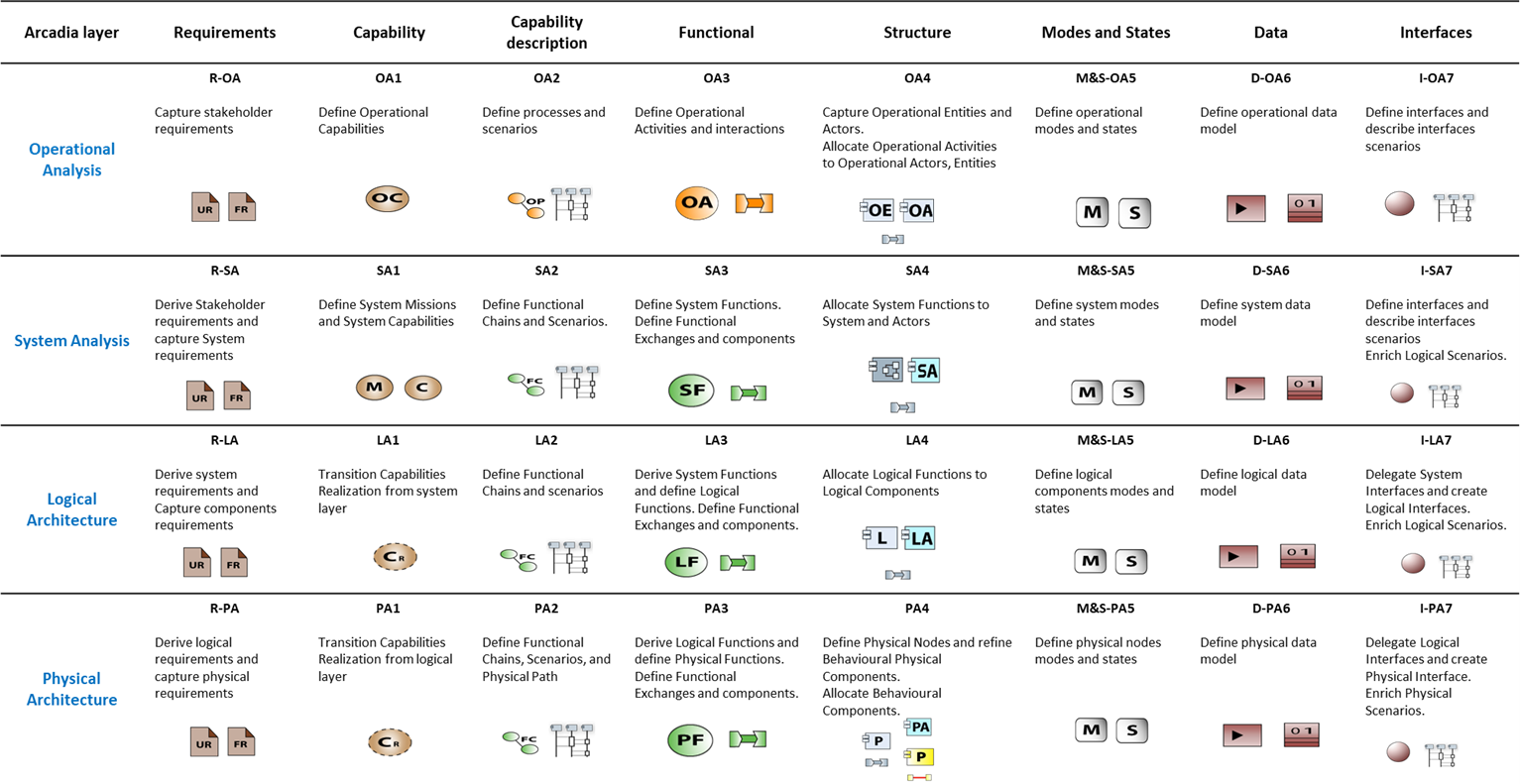
Arcadia is a tooled method devoted to systems & architecture engineering, supported by Capella modelling tool.
It describes the detailed reasoning to
It can be applied to complex systems, equipment, software or hardware architecture definition, especially those dealing with strong constraints to be reconciled (cost, performance, safety, security, reuse, consumption, weight…).
It is intended to be used by most stakeholders in system/product/software or hardware definition and IVVQ as their common engineering reference and collaboration support.
Arcadia stands for ARChitecture Analysis and Design Integrated Approach.
A series of online documents to dive into the principles and concepts of Arcadia:
Arcadia is a system engineering method based on the use of models, with a focus on the collaborative definition, evaluation and exploitation of its architecture.
This book describes the fundamentals of the method and its contribution to engineering issues such as requirements management, product line, system supervision, and integration, verification and validation (IVV). It provides a reference for the modeling language defined by Arcadia.
Jean-Luc Voirin, leader of the creation of the Arcadia method, along with some of the leaders on developing and deploying MBSE Arcadia & Capella practices in Thales. From right to left: Pierre Nowodzienski, Jean-Luc Voirin, Juan Navas, Stephane Bonnet, Frederic Maraux, Gerald Garcia, Philippe Fournies, Eric Lepicier.
Architecture as prime engineering driver
Arcadia, a model-based engineering method
Noticeable features of Arcadia
Definition of the Problem - Customer Operational Need Analysis
Formalization of system requirements - System Need Analysis
Development of System Architectural Design - Logical Architecture (Notional Solution)
Development of System Architecture - Physical Architecture
Formalize Components Requirements - Contracts for Development and IVVQ
Co-Engineering, Sub-Contracting and Multi-Level Engineering
Adaptation of Arcadia to Dedicated Domains, Contexts, Etc.
Equivalences and Differences between SysML and Arcadia/Capella
Title: Exploring the World of "Garden Takamine-ke no Nirin Ka": A Deep Dive into the Animation
Visual Quality: "Garden" (often associated with specific release groups or sites) may provide a version with higher bitrates, 4K upscaling, or corrected color grading.
Narrative Foundations and Premise At its core, Garden Takamineke no Nirinka is a story that intertwines the mundane aspects of school life with supernatural and psychological elements. The narrative centers on Takamine Ke (or Kei), a character who finds themselves in a complex web of relationships that serve as the focal point for the series' erotic content. garden takamineke no nirinka the animation 0 fixed
Themes
The Animation 0 Fixed is an edited and re-dubbed version of the original OVA, which became a viral sensation on the internet. The fixed version, often referred to as "Garden Takamineke no Nirinka: The Animation 0 Fixed," features an entirely new dubbing track with altered dialogue, sound effects, and music. This re-dubbed version quickly spread across online platforms, captivating audiences with its intentionally over-the-top and humorous style. Title: Exploring the World of "Garden Takamine-ke no
Someone wrote in a forum in 2014: "I think 'fixed' means they removed the part where you realize you were the ghost all along."
Art Style: Smooth animation and detailed character designs that stay true to the original visual novel art. Themes The Animation 0 Fixed is an edited
Nirinka did not look up. "Everything deserves a chance," she replied, voice steady as the watering can in her hand. "Even clocks."