

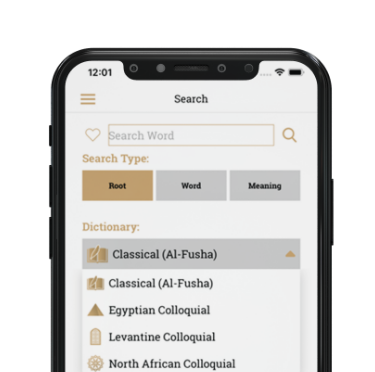
Want to take The Living Arabic Project's dictionaries wherever you go? Download the mobile app Lughatuna! It costs a little bit, but purchasing it supports the project so more cool dictionaries and new features can be added.


This site is always growing. What started out as a simple word list on a student’s desktop has evolved into two of the largest dialect dictionaries ever written for the Egyptian and Levantine dialects with plans for additional dialects and a growing Classical Arabic (Fusha) dictionary, all run on a uniquely structured database designed for Arabic’s diglossia. To make it practical and accessible, there are apps and learning resources appropriate for all levels of users.
Understanding why animals do what they do is the first step toward better medicine. Veterinary behaviorists study the intersection of mental health and physical health to provide more compassionate care. 🧠 The Mind-Body Connection
The intersection of animal behavior and veterinary science has numerous applications in:
Emerging frontiers include:
Below are key academic papers and foundational resources categorised by their focus within this discipline. Core Veterinary & Behavioral Science Papers Why Veterinarians Should Understand Animal Behavior
It is crucial to distinguish between a veterinary behaviorist (a DVM with specialized residency training in behavior) and a dog trainer (who lacks medical training). Understanding why animals do what they do is
As our understanding of animal behavior and veterinary science continues to evolve, we can expect to see:
Tinbergen’s Four Questions: Address the causation (mechanism), development (ontogeny), function (adaptation), and evolution (phylogeny) of the behavior you are studying. Advances in Animal Behavior Research : Current research
: A starter book for children that offers a gentle, behind-the-scenes look at different types of vet work, from small pets to wild animals.
Arabic is hard and complex, but also rich and deep. Imagine learning tools that map out Arabic for you and help you learn it. That’s what this site is. It has dictionaries for Egyptian, Levantine, and Classical Arabic, and it has apps and learning resources to help you access the language.
These dictionaries are more than just a list of words, they are guides to the Arabic language. The uniquely structured database allows users to search by Arabic word, English word, and Arabic root. There are also thousands of examples to show users how to properly use words and listing common phrases and proverbs.
Understanding why animals do what they do is the first step toward better medicine. Veterinary behaviorists study the intersection of mental health and physical health to provide more compassionate care. 🧠 The Mind-Body Connection
The intersection of animal behavior and veterinary science has numerous applications in:
Emerging frontiers include:
Below are key academic papers and foundational resources categorised by their focus within this discipline. Core Veterinary & Behavioral Science Papers Why Veterinarians Should Understand Animal Behavior
It is crucial to distinguish between a veterinary behaviorist (a DVM with specialized residency training in behavior) and a dog trainer (who lacks medical training).
As our understanding of animal behavior and veterinary science continues to evolve, we can expect to see:
Tinbergen’s Four Questions: Address the causation (mechanism), development (ontogeny), function (adaptation), and evolution (phylogeny) of the behavior you are studying.
: A starter book for children that offers a gentle, behind-the-scenes look at different types of vet work, from small pets to wild animals.
Do you have questions or comments?
Feel free to reach out through Contact us page.
